Showing posts with label gun violence. Show all posts

Wednesday, December 17, 2014

Two Years Since Newtown

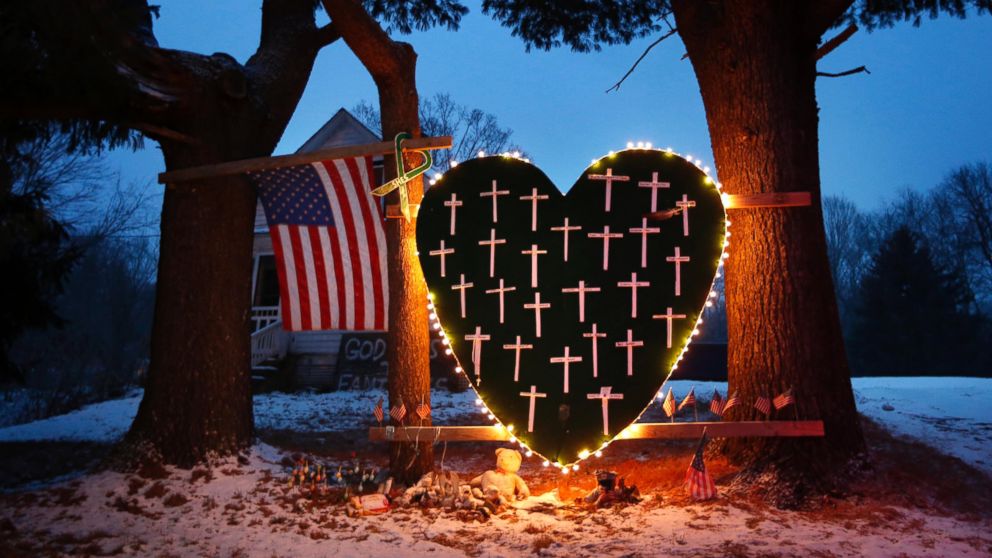
PHOTO: A memorial with crosses for the victims of the Sandy Hook Elementary School shooting massacre stands outside a home in Newtown, Conn., on the one-year anniversary of the shootings, Dec. 14, 2013.
Memorial in Newtown /Credit: AP (appeared on ABC News website)
Two years ago on December 14, 2012, a disturbed 20 year-old shot and killed his mother, then drove to Sandy Hook Elementary School in Newtown, Connecticut, and killed 20 children and 6 adults before turning the Bushmaster rifle on himself.  This shooting was supposed to be the one that finally changed everything about the availability of guns in the United States and our national epidemic of gun violence.   It has not.  Thanks to a powerful gun lobby and fanatic "gun rights" advocates, very little has changed at the national level.  It is a disgraceful reminder of the power of special interest group money to prevent legislation for the common good from being enacted.

In the two years since Sandy Hook, there have been 21 deadly school shootings in the United States resulting in 37 deaths, including 5 of the shooters.  Mark Follman at Mother Jones analyzes the past two years of these attacks in a December 9 post and adds that "During the same period, there have been dozens of other gun incidents on school grounds that caused injuries, as well as seven additional cases where someone committed suicide with a firearm, but no one else died."

While action has been minimal to non-existent at the national level, there has been some good legislation passed at the state level - most recently, in the state of Washington voters approved a ballot initiative requiring universal background checks in November.  The Law Center to Prevent Gun Violence summarizes the progress: "In the past two years, states have seen historic and unprecedented progress in adopting gun laws to help keep communities safe from gun violence. A total of 99 new laws strengthening gun regulations have passed in 37 states nationwide since December 12, 2012, and 10 states have made major overhauls to their gun laws. 2014 was a remarkable year for smart gun laws, with California’s Gun Violence Restraining Order law, Washington State’s successful ballot initiative for universal background checks, and seven states adopting legislation to keep guns out of the hands of domestic violence abusers."  You can check out its 2014 Annual Gun Laws State Scorecard at http://gunlawscorecard.org/.

In addition to the successful ballot initiative in Washington, gun-control advocates saw a few other victories on Election Day. In Colorado, the two state senators who were recalled in 2013 by a gun lobby funded recall vote won back their seats.  As the LA Times reported: "...in a little-noticed footnote to Colorado’s closely watched gubernatorial and U.S. Senate races, the Democrats won back both of those seats, and it wasn’t at all close in either Pueblo or Colorado Springs."  And, in the midst of what was a Republican rout, the Democratic governors of Connecticut and Colorado won re-election in November despite gun lobby efforts to unseat them.  Connecticut and Colorado passed some of the toughest gun legislation in the country after the tragedies at Sandy Hook and Aurora.

In recent news, the gun lobby suffered a defeat Monday when, in what CNN analysts called "a small political miracle", the Senate approved Vivek Murthy as Surgeon General.  The gun lobby and their allies on the right had delayed his appointment for more than a year because he dared to say that gun violence is a public health issue.

Also on Monday, the families of nine people killed at Newtown filed suit against the maker and sellers of the Bushmaster AR-15 rifle.  The suit alleges "wrongful death and negligence" and seeks unspecified monetary damages.  "The complaint says the gun allows shooters to inflict unparalleled civilian carnage.  'In order to continue profiting from the sale of AR-15s, defendants chose to disregard the unreasonable risks the rifle posed outside of specialized, highly regulated institutions like the armed forces and law enforcement," the plaintiffs wrote in the complaint...A 2005 law shields gun manufacturers from most lawsuits over criminal use of their products, but it does include an exception for cases where companies should know a weapon is likely to be used in a way that risks injury to others. A lawyer for the Newtown families, Katie Mesner-Hage, said the lawsuit appears to be the first of its kind against a manufacturer to claim that exception." [AP/Huffington Post, Dec. 15]

The public is way ahead of the politicians on this issue with overwhelming majorities favoring common sense gun regulations.  Referring to the re-election of Governors Malloy (CT) and Hickenlooper (CO), the Americans for Principled Leadership website notes: "The public polls on gun safety reforms have been proven out in these two gubernatorial elections. By lopsided majorities the voting public strongly favored the gun safety legislation put in place after the Aurora movie theatre and Sandy Hook Elementary School shootings. It’s only a question of time before other states catch on."

Photo Credit: smartgunlaws.org (Law Center to Prevent Gun Violence)
Once the laws are on the books, we can expect attacks from the gun lobby in the courts - usually on the basis of the Second Amendment.  On the district court level, 2014 saw a number of victories for common sense gun laws,  In September. "U.S. District Court Judge John Darrah handed the gun sense movement yet another legal victory by upholding a local ordinance that prohibits military-style assault weapons and large capacity ammunition magazines (“LCMs”) in the city of Highland Park, Illinois. The decision is the most recent in a growing string of cases unanimously finding that prohibitions on assault weapons and LCMs do not infringe on the Second Amendment...This outcome marks the tenth major court victory for common sense gun laws in 2014. Despite a concerted effort by the gun lobby to challenge a host of reasonable firearm regulations, courts have rejected Second Amendment challenges to laws ranging from universal background checks and firearm registration to safe storage and restrictions on assault weapons and LCMs. The message from the courts is clear: the vast majority of sensible gun laws are fully compatible with the Second Amendment."  [Law Center to Prevent Gun Violence, Sep. 29]

The positive state and local actions on gun regulation make these communities safer.  But other states have passed laws making guns more readily available and present.  Guns can be transported across state lines as easily as people, and action at a national level is also necessary. Unfortunately, after the midterm elections, action at the national level is now more unlikely than ever.

Then there is the question of the Supreme Court.  What will happen when these lower court cases make their inevitable way to the conservative-majority Supreme Court is anybody's guess.  SCOTUS' infamous District of Columbia vs. Heller 5-4 ruling in 2008 upheld a district court ruling that a Washington D.C. law banning handguns and requiring other firearms to be stored unloaded or locked was unconstitutional.  In so doing, they essentially declared that an individual unconnected to service in a militia had the right to "bear arms" - a first ever and unprecedented interpretation.

But the news at SCOTUS is not all bad.  In the court's last term (2013-4), "despite numerous invitations and opportunities, the justices went out of their way to avoid the right to bear arms.  Signs of this were clear...when the court in a 5–4 ruling upheld a major gun control law, the federal ban on 'straw' purchasing without so much as mentioning the Second Amendment." Justice Kennedy is apparently the swing vote on these issues and neither the conservative or liberal justices appeared willing to bet on which side he would vote if the Second Amendment were brought into the case.  "Kennedy seems increasingly less likely to be a solid vote for expansive Second Amendment rights. Indeed, twice [in the 2013-4] term he voted for expansive readings of gun control laws instead. For the NRA, so used to winning in statehouses around the country, this can't be good news." [Slate, June 19]

Related
Let's Repeal the Second Amendment [March 18, 2014]


Wednesday, October 15, 2014

Ebola - the threat, the heroes, the politics

On Friday of last week, the World Health Organization raised the number of confirmed or suspected deaths from the 2014 Ebola virus outbreak to 4,033 - greater than the death toll from all previous outbreaks.  And unlike previous outbreaks, generally confined to the villages where the disease appeared, the 2014 outbreak has spread to cities and countries outside the epicenter.  As reported by AP and carried by Huffington's World Post: "David Nabarro, the U.N. special envoy for Ebola, said the number of Ebola cases is probably doubling every three-to-four weeks and the response needs to be 20 times greater than it was at the beginning of October. He warned the U.N. General Assembly that without the mass mobilization of the world to support the affected countries in West Africa, 'it will be impossible to get this disease quickly under control, and the world will have to live with the Ebola virus forever.' "  Mathematical models performed by numerous researchers suggest that anywhere from 20,000 to 100,000 people globally could contract the virus by December of this year.  With the virus' 50% fatality rate, 10,000 to 50,000 could be killed by the epidemic. Hopefully, the world's governments will respond to this plea for mass mobilization and the worst case scenarios will be prevented.

There is no cure for the disease and no vaccine against the virus. Prevention and containment are the best defense.  Basic interventions, when provided early enough, can increase an infected patient's chances of survival,  From the CDC website:  Symptoms of Ebola are treated as they appear. The following basic interventions, when used early, can significantly improve the chances of survival:
  • Providing intravenous fluids (IV)and balancing electrolytes (body salts)
  • Maintaining oxygen status and blood pressure
  • Treating other infections if they occur
Recovery from Ebola depends on good supportive care and the patient’s immune response. People who recover from Ebola infection develop antibodies that last for at least 10 years, possibly longer. 

The heroes of this battle are the men and women fighting every day to save Ebola patients.  They are the ones putting themselves at risk to keep the epidemic in check.  The slightest imperfection in protective equipment or procedure can lead to infection and death.  Even when procedures are followed and protective equipment is used, it's possible to become infected as happened with one of the nurses treating the Dallas Ebola patient.  Whether they be part of the local response or the UN or Doctors Without Borders medical staff or the medical teams sent by countries like Cuba, they put their lives on the line every day.  The US is sending at least 4,000 troops to West Africa improving the infrastructure, helping with logistics and building treatment units.  The 101st Airborne is currently undergoing intensive safety training before joining the 350 troops already on the ground in West Africa.

Screening procedures are being put in place in many international airports - London's Heathrow, New York's JFK, Chicago’s O’Hare International, Atlanta’s Hartsfield-Jackson International and Newark Liberty International - to help stop the spread of the disease from countries with the highest level of infection.  The Economist notes that "African and Asian countries have been screening air passengers for months, with some using infrared cameras to detect fevers. This is in addition to the screening of all departing air travellers in the affected countries."  While these measures may help calm people, they will not completely stop the spread of the disease.   The article concludes "...the best way to stop Ebola from spreading, say health experts, is to drain the reservoir of the disease, which means tackling it in west Africa. Doing that presents an entirely different set of challenges. When it comes to stopping Ebola, the rich world's self-interest aligns neatly with the needs of the developing world. But countries in a position to help have been slow to act."

Here in the US, politics has raised its ugly head. Most recently, a key Republican Senator was blocking the transfer of $750 million (of the $1 billion requested by Obama) in Department of Defense funds to fight the disease because, among other things, the Defense budget was "thin". After realizing how ridiculous his position was, he dropped his objections.  Reuters reported Friday : "The U.S. Defense Department won permission to shift $750 million in war funds to fight Ebola in West Africa as a Republican senator on Friday lifted his remaining objections to the transfer.  The action by Senator James Inhofe of Oklahoma will give the Pentagon enough funding for about six months of operations in West Africa, including the deployment of up to 4,000 troops and the establishment some 17 Ebola treatment facilities with 100 beds each."  The bad news is that Republicans are still holding up $250 million of the original $1 billion request for transfer.

Inhofe says that "it will be difficult to support any further last-minute funding requests using military resources,"  Really? With 40% of the world's total military expenditures, we can surely find something we don't need in that bloated budget.  Inhofe asks for a "more appropriate" source of funding while we are still feeling the impact of the domestic program budget cuts that Republicans love so much.

The main agencies tasked with this aid work say they're "hamstrung by budget cuts from the 2013 sequester."  Sequestration caused budget cuts in the National Institute of Health's budget affecting every area of medical research.  Cuts to international aid budgets and to USAID totaling $700 million affected the detection and containment of the disease.  Dr. Beth Bell of the CDC testifying before a Senate committee, "argued that the epidemic could have been stopped if more had been done sooner to build global health security... 'If even modest investments had been made to build a public health infrastructure in West Africa previously, the current Ebola epidemic could have been detected earlier, and it could have been identified and contained.'" [Mother Jones, October 1]

The head of the National Institutes of Health, Dr. Francis Collins, pointed out the impact of a decade of stagnant funding for the agency (down 23% in current dollars).  "has 'slowed down' research on all items, including vaccinations for infectious diseases. As a result, he said, the international community has been left playing catch-up on a potentially avoidable humanitarian catastrophe.  'NIH has been working on Ebola vaccines since 2001. It's not like we suddenly woke up and thought, 'Oh my gosh, we should have something ready here,' Collins told The Huffington Post on Friday. 'Frankly, if we had not gone through our 10-year slide in research support, we probably would have had a vaccine in time for this that would've gone through clinical trials and would have been ready.' " [Huffington Post, October 12]

The US media have done a pretty good job of stirring up fears of a devastating outbreak of the virus here in the US despite statements from medical experts that there is little reason for that fear. Normally, the Surgeon General of the United States would be advising Americans and addressing the health concerns of the nation - what's real, what's not, what can be done, what precautions to take. But here too politics has had an impact.  Thanks to the NRA, we are without a Surgeon General overseeing the Ebola threat. "Last November 14th, the President nominated Dr. Vivek H. Murthy, an extremely qualified candidate to replace ‘acting’ Surgeon General Dr. Regina Benjamin. It took three months, but the Senate finally got around to holding a confirmation hearing for Dr. Murthy’s appointment. However, the National Rifle Association exerted its very substantial legislative prerogative and blocked Murthy’s confirmation because he...called for sane gun restrictions to prevent more Americans from dying unnecessarily from the gun violence epidemic. It is exactly what a real medical professional, and highly-qualified potential Surgeon General of the United States, is supposed to do; help prevent a deadly epidemic from spreading to save American lives." [PoliticsUSA, October 14]  More than 30,000 people are killed by gun violence each year.  The devastation caused by gun violence is order of magnitudes more devastating than the Ebola virus will ever be in this country.


Saturday, October 11, 2014

Sunday Roundup - October 12, 2014

This is the weekly selection of news and opinion from sources outside the US mainstream corporate media.  Today we look at the 2014 Nobel Peace Prize, America's longest war, Khorasan, gun law reform, Hong Kong, Ebola, and, in brief, recent Federal court decisions on voting rights.

Nobel Peace Prize
Nobel Peace Prize winners Malala Yousafzai and Kailash Satyarthi.
Photograph: Fabio De Paola for the Guardian
The 2014 Nobel Peace Prize has been awarded jointly to 17 year-old Pakistani child education activist,  Malala Yousafzai, and 60 year-old Indian child rights campaigner, Kailash Satyarthi.   The Nobel Committee noted that it "regards it as an important point for a Hindu and a Muslim, an Indian and a Pakistani, to join in a common struggle for education and against extremism."  At 17, Malala becomes the youngest recipient ever of the Peace Prize.  The teenager was shot in the head by Taliban gunmen in October 2012 for campaigning for girls' education...The Committee spokesman said "Despite her youth, Malala Yousafzai, has already fought for several years for the right of girls to education and has shown by example that children and young people too can contribute to improving their own situations...This she has done under the most dangerous circumstances. Through her heroic struggle she has become a leading spokesperson for girls' rights to education."   For more than 30 years, Mr. Satyarthi has been at the forefront in the fight against child slavery and exploitation.  Mr Satyarthi has maintained the tradition of Mahatma Gandhi and headed various forms of peaceful protests, "focusing on the grave exploitation of children for financial gain," the committee said at the Nobel Institute in Oslo.  The 60-year-old founded Bachpan Bachao Andolan, or the Save the Childhood Movement, which campaigns for child rights and an end to human trafficking. [BBC News, October 10]

Afghanistan
Thirteen year ago on October 7, the US began bombing Afghanistan.  That step marked the beginning of Bush's "war on terror", and the war in Afghanistan has become the longest in American history. Besides the loss of life, the Afghanistan and Iraq Wars will eventually cost the US between $4 trillion and $6 trillion.  This estimate was made before the latest American military operation in Iraq and Syria and assumes that nobody will listen to the Congressional hawks incredibly clamoring for tens of thousands more troops in the area.  Sadly, nearly 40,000 international troops - about three-quarters of them American - are still there.  The US recently signed a Bilateral Security Agreement with Afghanistan, which, as The Guardian reported on September 30, guarantees that US and NATO troops will not have to withdraw by year’s end, and permits their stay “until the end of 2024 and beyond.”  The entry into force of the deal ensures that Barack Obama, elected president in 2008 on a wave of anti-war sentiment, will pass off both the Afghanistan war and his new war in Iraq and Syria to his successor. In 2010, his vice-president, Joe Biden, publicly vowed the US would be “totally out” of Afghanistan “come hell or high water, by 2014.”  Almost 10,000 US troops will remain in Afghanistan after year-end.

Khorasan
Since ISIS was acknowledged to have no intention of bringing its jihad to the US, the Administration was having a hard time justifying its bombing campaign in Syria.  Enter Khorasan - an unheard of jihadist group allegedly with designs to attack the "homeland" - to save the day for the militarists.  Glenn Greenwald and Murtaza Hussain in a hard-hitting report in The Intercept disclose how the Administration and the military created a wholesale concoction of a brand new terror threat that was branded “The Khorasan Group"...Seemingly out of nowhere, a new terror group was created in media lore.”   Greenwald and Hussain document the growth of the "Khorasan threat" in the media. The Obama administration needed propagandistic and legal rationale for bombing yet another predominantly Muslim country. While emotions over the ISIS beheading videos were high, they were not enough to sustain a lengthy new war.  So after spending weeks promoting ISIS as Worse Than Al Qaeda™, they unveiled a new, never-before-heard-of group that was Worse Than ISIS™. Overnight, as the first bombs on Syria fell, the endlessly helpful U.S. media mindlessly circulated the script they were given: this new group was composed of “hardened terrorists,” posed an “imminent” threat to the U.S. homeland, was in the “final stages” of plots to take down U.S. civilian aircraft, and could “launch more-coordinated and larger attacks on the West in the style of the 9/11 attacks from 2001.”... But once it served its purpose of justifying the start of the bombing campaign in Syria, the Khorasan narrative simply evaporated as quickly as it materialized. Foreign Policy‘s Shane Harris, with two other writers, was one of the first to question whether the “threat” was anywhere near what it had been depicted to be...On September 25, The New York Times — just days after hyping the Khorasan threat to the homeland — wrote that “the group’s evolution from obscurity to infamy has been sudden.” And the paper of record began, for the first time, to note how little evidence actually existed for all those claims about the imminent threats posed to the homeland. Besides the exaggerated "imminent threat," there were serious questions about whether the Khorasan Group even exists in any meaningful or identifiable manner.  Tom Englehardt in his October 7 post at TomDispatch "Inside the American Terrordome" takes aim at the terror-phobia and the "soundtrack of hysteria" that has gripped this country since the attacks of September 11.  Referencing the Greenwald/Hussain report, he writes:  the whole Khorasan story began to disassemble within a day or so of the initial announcement and the bombing strikes in Syria.  It took next to no time at all for that “imminent threat” to morph into “aspirational” planning; for reporters to check with their Syrian sources and find that no one knew a thing about the so-called Khorasan Group... As ever, however, pointing out the real dangers in our world was left largely to non-mainstream sources, while the threat to our way of life, to Washington and New York, lingered in the air.

Gun Laws
In its October 6 issue, The Nation asks "Whatever happened to gun control?"  The Newtown tragedy was supposed to change everything about gun politics.  It hasn't.  The Nation considers Congresswoman Elizabeth Esty's (D-CT) Congressional race.  It's close and she is one of 25 Democratic Representatives considered at risk of an upset.  Esty represents the district that includes Newtown and has been a champion of tougher gun control laws.  She co-sponsored a raft of gun-violence prevention bills in the House, including the only gun-control measure to pass Congress after Newtown—a bill to provide $19.5 million to improve the federal background-check system...But twenty-one months after the shootings and with the midterm elections approaching, Esty is facing a situation that would have seemed absurd and even impossible [in the days after Newtown]: her opponent, Mark Greenberg, opposes new federal gun laws.  Newtown was supposed to change everything—and for a moment, it appeared it had. Support inside Connecticut for stricter gun laws approached 60 percent in the months after the shooting. In April 2013, a package of reforms touted as the “toughest gun laws in the country” passed the Legislature with wide bipartisan support and was signed into law by Democratic Governor Dannel Malloy. But now, most polls show Malloy trailing his Republican opponent, Tom Foley, who opposes new gun laws. How did it happen?  And how did the proposals for reasonable measures to prevent gun violence get stymied at the Federal level?  The NRA was even in negotiations on a universal background check bill.  But persistent misinformation and agitation by far-right members of Congress and gun groups even more rigid than the NRA slowly doomed the effort. Republicans who said they’d support background-check legislation started to waver, often citing bogus fears of a national gun registry that the bill explicitly forbade. The NRA began feeling the heat from groups like Gun Owners of America, which urged a no-compromise approach, and its lobbyists dropped out of the negotiations.  In spite of the unlikelihood of any Congressional action on preventing gun violence for the foreseeable, The Nation is encouraged by the laws passed at the state level.  An untold story of the post-Newtown debate over gun control is how much happened at the state level: while the national media deemed gun control impossible after Congress failed to act, eight states made significant or sweeping changes to gun laws, while only four states significantly weakened them, according to analysis by the Law Center to Prevent Gun Violence. Mark Follman at Mother Jones crunched the numbers and found that more than half of all Americans now live in a state with stronger gun control laws than existed before Newtown. Washington State, Nevada and Illinois have initiatives on the 2014 ballot so there may be even more progress.  Many people are getting involved outside the electoral and legislative arenas as well by joining a wide-ranging movement to keep guns out of public spaces.  Americans for Responsible Solutions is "micro-targeting" specific groups for support of reforming gun laws and there is real optimism among the various reform groups,  But on the national level, for these mid-terms at least, candidates are treading cautiously with the result that in an election cycle with no overriding theme, gun control occupies a place somewhere alongside farm subsidies or the Export-Import Bank as an issue on the campaign trail. 

Hong Kong
The Hong Kong student protests are petering out.  With numbers shrinking rapidly, and hopes of winning meaningful reform fading even faster, the question now is what lies ahead for these “angry – but peaceful” young men and women. Will the unprecedented protests embolden them to fight for their beliefs in future, or convince them that resistance to Beijing’s will is futile? “People are criticising what we are doing as pointless and saying we won’t achieve anything, but history has shown us that is not the case,” student leader Joshua Wong told the crowd last week. “All our actions are like planting a seed.”...Beijing’s attempts to introduce a draconian national security law in 2003 and “patriotic education” in 2012 were turning points. Then came the decision to tightly restrict the long-promised universal suffrage.  “People are finally saying: This is it – this is the end – and this has fuelled this sudden anger and frustration,” Hong Kong-based author Suzanne Pepper said.  There are economic as well as political reasons for the protests.  The emphasis on tourism and an influx of mainlanders has increased the competition for professional jobs, housing and seats on public transport.   The salaries of young people are down, in real trerms, about 15-20% since 2000 housing prices are soaring, and income inequality is among the highest in the developed world.  [The Guardian, October 7]  Change, if any, will come slowly.  Hong Kong officials had agreed to meet with student representatives but then called off a meeting [scheduled for] Friday with student leaders of the pro-democracy movement.  Chief Secretary Carrie Lam said it would be "impossible to have a constructive dialogue" after protest leaders called for an increase in efforts to occupy main protest areas.  [BBC, October 9]

Ebola
The (US) Centers for Disease Control and Prevention (CDC) sent a team to Nigeria to learn more about how Nigeria managed to contain the outbreak there so effectively.  Ebola first arrived in Lagos, Nigeria—one of the largest cities in the world—on July 20. Global health officials feared the worst, warning that the disease could wreak untold havoc in the country.  But it hasn't turned out that way. To date, Nigeria has reported only 20 confirmed or probable Ebola cases in a nation of 174 million people. Equally remarkable, there have only been eight deaths...In fact, Nigeria could be declared Ebola-free as early as October 12.  The Nigerians' success resulted from early identification, isolation and treatment, a coordinated approach with a center of operations, and fast tracking of contacts of the infected person.  [Mother Jones, October 10]  Meanwhile, Republican Senators are blocking approval of the transfer of $1 billion in funds in the DOD budget to combat the disease - partly because it focuses on Africa rather than the US and partly because of the "thin" Defense budget (Note: the US military budget is nearly 40% of the global total spent on the military. $1 billion is less than 0.2% of our military budget). You can't make this stuff up. Read more on these latest obstructions at The Daily Kos.   And at The Nation.
UPDATE: Senator Inhofe, the Senate Armed Services ranking Republican, lifted his objections and $750 million of the requested $1 billion will be transferred. [Reuters, Oct. 10]

In Brief - Voting Rights
"A Wild Week for Voting Rights" [Liz Kennedy at Demos, October 10] - The Supreme Court began its term by reinstating voting restrictions in Ohio and North Carolina after federal appeals courts put these laws on hold for unfairly burdening voting rights, particularly for people of color...[On October 9], the Court took action to stop Wisconsin’s voter ID requirement from going into effect only weeks before Election Day, and a federal court struck down Texas’s voter ID law after a trial on the merits, ruling for voters in both cases.  
[Update: The US Supreme Court reversed the Texas trial court's decision on Saturday, October 18. The discriminatory Texas ID law will be in effect and could disenfranchise as many as 600,000 voters.]

Wednesday, June 11, 2014

Sunday Roundup - June 15, 2014

This is the weekly selection of news and opinion from sources outside the US mainstream media. Today we look at Syria, pro-gun antics, the State Senator sellout and the Tea Party victory in Virginia, and Iraq.

Syria
According to the UN, more than 160,000 people have been killed in Syria's civil war.  Nearly three million refugees have sought sanctuary abroad and six million people have been displaced inside the country.  Syrian President Bashar al-Assad was re-elected to his third seven-year term on June 3 in an election held in government controlled areas.  On June 9, Assad announced a wide-ranging amnesty.  As reported by the Reuters news agency: In a decree published by state media, Assad commuted some death sentences to life imprisonment, reduced jail terms for many offences and canceled some others altogether.  Foreigners who entered the country "to join a terrorist group or perpetrate a terrorist act" would receive an amnesty if they surrender to authorities within a month, the decree said. Kidnappers who free their hostages and army deserters would also be covered.   On June 10, Reuters reported on the  internecine fighting among Assad's mainly Sunni Muslim opponents.  A six-week offensive by the Islamic State in Iraq and the Levant (ISIL) against rival Islamists in eastern Syria has killed 600 fighters and driven 130,000 people from their homes...The group follows al Qaeda's jihadist ideology but its leader Abu Bakr al-Baghdadi has defied orders by al Qaeda leader Ayman al-Zawahri to stop fighting in Syria and focus on Iraq. The UK-based Observatory said 241 fighters from ISIL and 354 from Nusra and other Islamic brigades had been killed in fighting since ISIL launched its offensive in Syria's Deir al-Zor province, seizing four oilfields from its rivals. Civilian deaths are estimated at 39.

Gun Violence

Mass shootings continue in the US with no Congressional action to even establish standards for universal background checks anywhere in sight.  Among other shootings in the past several weeks, a couple allegedly at the Cliven Bundy ranch shot to death two Las Vegas police officers and a bystander.  In a June 10 post, The Daily Kos analyzes the disappearance of the Tea Party terrorist story from Fox News reports after just one day.  Ordinarily, Fox, or any news operation, would grasp dearly to a story that had the emotional punch of police officers murdered in an ambush. It has the drama of a horrific crime and the sympathy reserved for a community's fallen heroes. For Fox to forgo all of that makes it clear that they are afraid of their own audience. They are not going to risk upsetting them with a story that indicts their most closely held principles. And Fox is surely not going to indulge in a story that contradicts everything they have stood for over the last seventeen years.

Meanwhile just when you thought the anti-gun-control fanatics couldn't get any nuttier, we are treated to the spectacle of packs of Open Carry Texas members carrying their rifles into commercial establishments and hounding gun control advocates, the NRA criticizing OCT actions and then retracting its criticism, "Joe the Plumber" insisting to parents of children killed at UC-Santa Barbara that the deaths of innocent people "don't trump" his constitutional rights, and a loaded gun being found in the toy aisle of a Target in South Carolina. Perhaps some of these pro-gun activists are afraid of universal background checks because they act so bat-shit crazy that, in any civilized society, they would be deemed unsuited to carry weapons.  President Obama asked for us as a nation to do some soul-searching and that may be all that happens for the foreseeable future on a Federal level.  With NRA money backing so many in Congress and with Republicans in control of the House of Representatives, don't expect too much by way of courageous action to stop the American gun slaughter.  


Virginia Doings
Referring to what appears to have been the bribery of a Democratic state senator by Virginia Republicans, Zoe Carpenter writing in The Nation wonders "What won't the GOP do to keep the poor uninsured?" Phillip Puckett, who served as a Democratic state senator for one of Virginia's poorest districts, resigned suddenly on Monday. His decision to step down appears to have been the result of a bribe offered by Republican colleagues bent on stopping the expansion of Medicaid. Puckett’s resignation gave Republicans the one seat they needed to take control of the Senate; it also put him in the running for a paid post on a state tobacco commission that is controlled by some of the very same Republicans. And it cleared the way for the chamber to appoint his daughter to a state judgeship. Turns out Puckett, in view of the uproar, may not be taking the post at the state tobacco commission.  But the damage was done.  By stepping down, Puckett effectively ended a months-long battle over the fate of the 400,000 Virginians who are too poor to buy insurance but don’t meet the state’s restrictive eligibility requirements for Medicaid. The state Senate had been on course to vote to expand the program under the Affordable Care Act, setting up a budget showdown with the Republican-controlled House. But with the GOP now in control of the Senate, both chambers are expected to pass a spending plan on Thursday that does not include the expansion.  Virginia is not the only state where Republicans have gone to insane lengths to keep millions uninsured, or to justify doing so.  Carpenter cites Missouri, Louisiana, Utah and Arkansas as examples of these Republican efforts.

In other Virginia political news, House Majority Leader Eric Cantor was deemed too moderate (wow, Cantor pressured Boehner from the right!) for the likes of his constituents.  David Brat, an obscure right-wing professor of economics, supported by the Tea Party but outspent 25 to 1 by Cantor, defeated Cantor by 11 percentage points.  How did this happen? New York Magazine assessed it this way:  Brat ... benefited from the constant undercurrent of discontent emanating from the base that House Republicans had accommodated President Obama by failing to force him to accept their agenda — the still-extant pangs of anger that drove the party to shut down the government last fall.  But the biggest issue by far was immigration reform. Cantor was no reformer, really. He rejected the bipartisan immigration reform deal ...but he did hope to salvage some partial compromise, perhaps allowing some illegal immigrants who had been brought over the border as children.... Brat rejected even that. Any token of conciliation was too much. He still uses the old lingo, calling undocumented immigrants “illegals.” The chortling on the Democratic side has begun.  They are glad that Cantor has been defeated.  I wonder what they can possibly be thinking.  He was replaced on the 2014 Republican ticket in a secure Republican district by someone even further to the right than he is. Albeit this was one of the few Tea Party victories against the Republican establishment candidates in this primary season.


Map is from uniraq.org

Iraq
Iraq is facing its gravest test since the US-led invasion more than a decade ago, after its army capitulated to Islamist insurgents who have seized four cities and pillaged military bases and banks, in a lightning campaign which seems poised to fuel a cross-border insurgency endangering the entire region.  [The Guardian, June 11]  Al-Qaeda-linked extremists seized control of Nineveh province and Mosul, Iraq’s third-largest city.  It puts terrorists in control of an enormous part of Iraq’s north and west.   As Bob Dreyfuss in a June 10 article in The Nation so correctly puts it: The crisis now engulfing Iraq provides the ultimate condemnation of the decision by George W. Bush, Dick Cheney and their cohorts—backed, of course, by Hillary Clinton and John Kerry—to invade Iraq in 2003. That action, which destroyed virtually all of Iraq’s institutions and created a power vacuum that led directly to an ethnic and sectarian civil war, is now playing out all of its terrible consequences.  The ongoing sectarian violence has taken a staggering toll in Iraq - with more than 8,000 killed in 2013 and monthly totals that suggest an even higher number of deaths this year; in May, 799 Iraqis died as the result of suicide bombings, car bombs, targeted assassinations, tit-for-tat killings and other civil war–like violence, according to the United Nations—and that data doesn’t even include Anbar province. 

Mother Jones, June 13 post: "What the Hell is Happening in Iraq Right Now?"


Saturday, May 31, 2014

Sunday Roundup - June 1, 2014

This is the weekly selection of news and opinion from outside the US mainstream corporate media. Today we look at the Greenpeace and the Amazon rainforest, Pope Francis in Bethlehem, the New Populism conference, US gun violence, Guantanamo, and Ukraine.


Greenpeace and the Amazon
Amazon parrot (Greenpeace)
Greenpeace has turned its focus once again towards the Amazon rainforest - specifically, the illegal logging there. Besides being one of the most diverse ecosystems in the world (an estimated one-quarter of all known land and fresh water species live there), the rainforest is also one of the world's largest "carbon sinks", thus playing a major role in reducing the impact of human-induced climate change.  On May 15, Greenpeace released its report "The Amazon's Silent Crisis".  Describing how deforestation increases the risk of runaway climate change, the report warns that as climate change impacts are felt, there are concerns that the Amazon forest may reach a ‘tipping point’ in which it undergoes a rapid transition to savannah.  Besides deforestation (or clear-felling), selective logging is an important agent of forest fragmentation and degradation of the forest’s ecological integrity.  Even though the damaging selective logging of mahogany of the past has been stopped, selective logging remains a massive problem in the Amazon...If left unchecked, forest fragmentation will ultimately lead to the disappearance of whole tracts of forest. One of the main drivers of fragmentation today is the demand for high-value species such as Ipê.  In some states, as much as half to three-quarters of the logging is done illegally.  According to the Brazilian Institute of Environment and Renewable Natural Resources, the federal environmental agency responsible (alongside state environmental secretariats) for monitoring and inspecting the Amazon timber industry, in Maranhão and Pará states alone almost 500,000m³ of timber had fraudulent documents in 2013 – enough to fill 14,000 trucks.  Greenpeace calls for a different way of approaching the forest and those whose livelihoods depend on forest products... Investment and capacity building need to be focused on giving communities the skills to undertake quality community forest management. The Brazilian government must strengthen the regulation of timber harvesting, and the enforcement of regulations. Command and control measures and monitoring systems should be transparent and able to operate in real time.  


Pope Francis in Bethlehem
Pope Francis at the separation barrier (AP photo appeared in The Guardian)
Pope Francis' trip to the Holy Land drew much attention from the world's press.  The Guardian, May 25:  It is an image that will define Pope Francis's first official visit to the Holy Land. Head bowed in prayer, the leader of the Catholic church pressed his palm against the graffiti-covered concrete of Israel's imposing "separation wall", a Palestinian girl holding a flag by his side. It was, as his aides conceded later, a silent statement against a symbol of division and conflict.

Al Jazeera, May 25:  On his second day of a visit to the Holy Land, the pope on Sunday called for Palestinians and Israelis to work together, saying the breakdown in talks between the two sides earlier this year was "unacceptable".  "In this, the birthplace of the Prince of Peace, I wish to invite you, president Mahmoud Abbas, together with president Shimon Peres, to join me in heartfelt prayer to God for the gift of peace," he said during mass in Manger Square. The offer was accepted by both sides.  He then made [an] unscheduled stop at the Israeli separation wall, which divides Bethlehem and Jerusalem. The pope prayed for five minutes near an Israeli military watchtower, near graffiti which read, "Pope, we need someone to speak about justice", "Free Palestine" and a reference to the Warsaw ghetto.  The pontiff had earlier made references to Palestinian statehood, and addressed Christians with words of encouragement....The pope called for forging a peace that "rests on the acknowledgment by all of the right of two states to exist and to live in peace and security within internationally recognised borders".  

New Populism
As I see it, the drivers behind the "New Populism" in the US are simple:

  • The majority of the American people support economic fairness and other progressive tenets
  • But this doesn't translate into public policy because politicians are too timid and/or too influenced by big money to enact populist measures
  • All popular social movements start with the people and it's up to us to influence our political leaders - to bring them along, so to speak, to the progressive positions held by the majority.
Whether or when the movement will be successful is a matter of debate.  It's certainly not going to happen any time soon.  Almost no coverage was given to May 22's New Populism Conference in the press or media.  I guess it's easier to get attention when you're spouting divisive, fear-mongering rhetoric than when you're proposing measures to promote justice and fairness.  People's World covered highlights of the conference, which was held at the Washington Court Hotel and attended by about 500 activists.  

Maya Rockeymoore, President of Global Policy Solutions, noted that the X and Y generations have been so badly economically screwed by the great recession they will not recover for the rest of their lives. Black families have been excluded from the economy for 80 percent of U.S. history. The Supreme Court is in the back pocket of the Republican majority that has taken over state government in multiple states....Sen. Elizabeth Warren spoke of the moneyed interests who spent more than $1 million per day for one year to fight the creation of the Consumer Financial Protection Bureau....She reminded us that rebuilding the middle class, equal pay for equal work and raising the minimum wage are not just slogans but legislative bills. She urged the audience to "make (legislators) vote as often as possible" on these and other progressive issues....Sophia Zaman, president of the U.S. Student Association, concluded her talk stating that what the millennial generation needs...is a strong progressive movement; one that supports quality union jobs, reduction of student debt, divestment from fossil fuels. In return, progressive youth are building power that goes beyond elections...Sen. Bernie Sanders (I-Vt.) ...cautioned..."Now is not the time to turn our backs on the political process." Rather we need to continue to push the middle class's issues of jobs, rebuilding infrastructure, raising minimum wage, creating more daycare, making higher education free, and amending the constitution to end the unlimited power of billionaires.  "There are more people living in poverty than ever in U.S. history," he said, but by increasing workers' participation in elections by only 5 percent (from 60 percent to 65 percent) progressive goals can be achieved.


US Gun Violence
A few of the posts in the aftermath of the UC-Santa Barbara tragedy last weekend:

This is what legislative courage on gun control looks like [Daily Kos, May 28]

The Mother Jones Facebook page has a discussion of its Jan 2013 post "10 Pro-Gun Myths Shot Down"

The Onion, the digital news satire organization, condemns the political  paralysis that prevents a solution: ‘No Way To Prevent This,’ Says Only Nation Where This Regularly Happens [The Onion, May 27]

Guantanamo
On May 29, Andy Worthington wrote in Al Jazeera of the lack of progress on releasing prisoners from Guantanamo.  A year after Obama's promise to resume releasing prisoners from Guantanamo, 78 men cleared for release are still there.  Worthington notes the Congressional obstacles and Obama's inability to overcome those obstacles.  Obama touched on Guantanamo in a speech about America's foreign policy at the United States Military Academy at West Point.  The president said, "I believe in American exceptionalism with every fibre of my being. But what makes us exceptional is not our ability to flout international norms and the rule of law; it's our willingness to affirm them through our actions. That's why I will continue to push to close GTMO - because American values and legal traditions don't permit the indefinite detention of people beyond our borders." One year on from his promise to resume releasing prisoners from Guantanamo, the president's words were as commendable as ever, but unless they are followed up with relevant actions they will reveal nothing but a gulf between words and action that has become rather predictable over the last five and a half years. 

Ukraine
The partially-boycotted presidential elections in Ukraine provided an overwhelming majority vote to EU-leaning billionaire Petro Poroshenko.  Violence between the government and separatist forces continued unabated in the ensuing days.  The Guardian May 26 editorial struck a somewhat optimistic note - not about the ongoing violence but about the hope for an eventual end to it.  It may be that, in spite of the dangers represented by events like the battle for Donetsk airport, Ukraine has turned the corner. Invasion is yesterday's threat, the extreme federalisation which Russia apparently wanted at an earlier stage has also faded as an idea, and the separatists in the east now seem more on their own than they were before. We are perhaps heading back to a more "normal" situation in which Moscow will still have a great deal of leverage in Ukraine, especially through its control of gas supplies and prices, and will lay down some red lines, but otherwise accept that for the time being the country has made a European and not an Eurasian choice.


Wednesday, May 28, 2014

Stop the Madness

“I don’t care about your sympathy. I don’t give a s--t that you feel sorry for me...Get to work and do something. I’ll tell the president the same thing if he calls me. Getting a call from a politician doesn’t impress me.” - Richard Martinez, Santa Barbara gun victim's father

This weekend's tragedy in Santa Barbara leaves us wondering what will it take to get the country to confront the widespread availability of guns that lies at the heart of our developed-world-leading murder rate.  The craven toadies in Congress beholden to the NRA have done nothing - not after Sandy Hook, not after Gabby Giffords' shooting, not after the D.C. navy yard, not after any number of other recent mass shootings.  Gun lobby apologists and paranoid wing-nuts stifle any discussion of our unreasonably lax gun laws.

Comprehensive Federal gun control laws are a must if we are going to ever stop the ongoing killings in our communities.  The first and minimum step is a universal background check law with no loopholes, with annual renewal requirements for possession of a gun combined, and with severe civil and criminal penalties for non-compliance.  I'm amazed to read officials and pundits decrying how helpless we are in "identifying potential killers".  Well, if the mentally unstable and violent felons couldn't get their hands on weapons under any circumstances, you would eliminate that concern, wouldn't you?

And if the NRA complains about a national gun registry - well, tell them to go screw themselves.  That is exactly what is needed.  I mean if you have nothing to hide, why would you be against it?  If we require car registrations and driver licenses to be renewed, why shouldn't we require the same of guns and gun owners?

Then there's the disturbing trend of gun extremists threatening women.  Mother Jones reports on the attacks against paralyzed gun reform advocate Jennifer Longdon in a May 15 post and notes that these attacks are not isolated incidents:  "Ever since the Sandy Hook massacre, a small but vocal faction of the gun rights movement has been targeting women who speak up on the issue—whether to propose tighter regulations, educate about the dangers to children, or simply to sell guns with innovative security features. The vicious and often sexually degrading attacks have evolved far beyond online trolling, culminating in severe bullying, harassment, invasion of privacy, and physical aggression."


(There are other videos and photos in the Mother Jones article.  This one is, believe it or not, one of the less offensive.  These videos and photos add a whole new dimension to the phrase "gun nut".)

Kudos to Chipotle and Starbucks and the others who've taken a step towards sanity by discouraging or prohibiting guns from being brought into their establishment.  But individual, private actions will never be enough to stem the country's gun violence.  Comprehensive Federal action is needed and it is needed now. Maybe there will be some movement on meaningful gun legislation in the coming days or maybe the NRA and its apologists will once again thwart even a minimal step towards restoring sanity to our gun laws.

Links
80 killed by guns in week prior to Santa Barbara


Tuesday, March 18, 2014

Let's Repeal the Second Amendment

One of the many pieces of legislation bottled up by the do-nothing-Republican-controlled-and-Republican-filibustered Congress is gun control regulation.  Even after Sandy Hook, Republicans managed to prevent meaningful Federal gun legislation from being enacted - not even the requirement for universal background checks or a ban on assault rifles.  Recourse to the courts for a common sense interpretation of the Second Amendment for the common good is useless.  The Republican majority on the Supreme Court refuses to recognize "A well regulated militia being necessary to the security of a free State" as the clearly dependent introductory clause that it is.

While some states have advanced tougher gun laws, others are moving into the deep end of the bizarre.  Georgia's State House of Representatives has drafted what's been called the "most extreme gun bill in America" by Americans for Responsible Solutions.  "Georgia lawmakers could soon make broad changes to the state’s gun laws to allow firearms in bars, churches, airports, and certain government buildings." [MSNBC/March 14]  What in hell could these fools be thinking?  In Georgia, no permit is needed to purchase a handgun and the state has the 9th highest firearm homicide rate in the country. 

NRA money continues to flow into Colorado to upend the stronger gun laws passed there last year.  The NRA has been able to defeat two state senators instrumental to the passage of the gun legislation in recall elections.  But so far they have had little success in overturning the laws as Democrats are holding on to a majority in the state legislature.  Seven of the eight bills introduced by the pro-gun industry  have been defeated - Concealed Handgun Carry without a Permit, Ammunition Magazine Prohibition. Concealed-Carry in Public Schools, Governor Cannot Restrict Firearms During Emergencies, No Background Check for Step-Relations, Concerning Background Checks and Fees for Gun Transfers, Repeal Large-Capacity Ammunition Magazine Ban.  One (Repeal Regulations on Firearms Purchases in Contiguous States) passed the State Senate and is pending in the House. This last bill, according to John Morse of Americans for Principled Leadership. "actually addresses an outmoded 1969 state statute that has subsequently been eclipsed by the Brady Bill and other federal legislation passed more recently....No harm is being done with this clean up measure."

According Slate.com's gun death tally, more than 12,000 people were killed by guns in the US between the time of the Sandy Hook shooting and Dec. 31, 2013.  Add to this the 20,000 suicides per year and the need for common sense regulation of guns becomes clear.  Mental illness, socio-economic factors, gang violence, guns in the hands of felons - these all contribute to the totals. But taking guns out of the hands of those prone to use them against others or themselves and taking assault rifles out of everybody's hands would make the totals significantly lower.

Every study and every statistic point to the connection between the availability of guns and gun-related deaths.  The gun homicide rate in the US with its relatively lax gun laws is vastly higher than that in other developed countries - 10 times that of Italy and 90 times that of the United Kingdom, for example.  [Wikipedia]  The largest study of gun violence in the United States, released in September 2013, "confirms a point that should be obvious: widespread American gun ownership is fueling America’s gun violence epidemic...[The authors found] “for each 1 percentage point increase in proportion of household gun ownership,...firearm homicide rate increased by 0.9 percent." [Think Progress website]  A Harvard study found that states with the strongest/most gun laws had a firearms death rate 42% lower than the states with fewest controls on guns.  The authors take pains to note that "You can’t necessarily say one absolutely led to the other … but you can say those things are related.”   I found one of the reasons for their hesitation absolutely incredible.  “One of the major challenges that has existed over the past 15 years is that basically all avenues of federal funding – either the CDC or the NIH – have been cut off from studying firearm fatalities,” [the author Dr. Eric] Fleegler said. ”I’m a pediatric emergency medicine doctor. If there are ten children who die from a toy or some sort of injury, there is an incredible human cry that we make sure that we stop those types of deaths. Here on the other side you have 31,000 people who die every single year from firearms. That is a number of deaths on virtually an unprecedented level, and nothing is being done to understand this or reduce it.” [Here & Now webpage, Boston Public Radio website]

I cannot get the objection of those who oppose universal background checks.  If you personally have nothing to hide, why are you reluctant?  I cannot get the point of those who would make possession of high capacity magazines and assault rifles the right of every mentally unstable American.  Under what circumstances other than mass murder or civil insurrection would you ever need these?  Please don't say hunting.  And I really can't get why Federal funding has been cutoff from studies of gun violence. What are they afraid we'll find out?

Maybe it's time to repeal the outmoded second amendment or at least interpret it in a manner consistent with the amendment authors' intent.  It was written at a time when muskets had to be powdered and reloaded after every shot, when America was a rural nation, when some were worried that the country would be reclaimed by Great Britain and, probably most importantly, when the militia were the only means of defense.  As Dan Heaton writes at Yahoo Voices: "After the Revolutionary War, the standing army of the new country essentially ceased to exist and the various state militias were again the primary means of national defense." .In other words, the militia granted the right to bear arms was the equivalent to today's armed forces.  No other Western democracy has anything like this enduring anachronism from the eighteenth century and they are surviving just fine, thank you.

In Brief - Updates on Issues We've Been Following
U.S. Accidental Shootings mid-February to early March

Oregon and Montana became the fourth and fifth states to restore Congressional food stamp cuts. They joined New York, Connecticut, and Pennsylvania.  Of the 14 states and the District of Columbia affected by the cuts, at least seven states (Connecticut, Montana, New York, Oregon, Pennsylvania, Rhode Island and Vermont) plus D.C. are moving or have already moved to block them, according to a Stateline survey. The remaining "heat and eat" states  — California, Maine, Massachusetts, Michigan, New Jersey, Vermont, Washington and Wisconsin — are considering doing the same.

Senate negotiators struck a bipartisan deal on March 13 that would renew federal unemployment benefits for the long-term jobless.  The bill could come up for a vote in the Senate by the end of March but its fate in the Republican-controlled House is up in the air.

President Obama rolled out his plan to "force American businesses to pay more overtime to millions of workers, the latest move by his administration to confront corporations that have had soaring profits even as wages have stagnated."

The people of Crimea voted overwhelmingly to rejoin Russia on Sunday.  On Monday the US and EU announced announced personal sanctions against Russian and Crimean officials.

Louisiana's lawsuit against MoveOn's billboards advocating Medicaid expansion


Wednesday, October 23, 2013

Gun Deaths, the Second Amendment and the NRA

The shooting tragedy at the Nevada middle school this Monday has brought gun violence back to the nation's attention.  A twelve year old, a seventh grader, wounded two students, killed a teacher and then killed himself.  It's not a mass shooting (there have been 16 mass shootings since Newton) so it won't stay in the news cycle for long.  But it's the kind of tragic event that should give us all pause to think what the American attitude towards guns is costing the nation.  Scott Sonner (AP/Huffington Post) reported Tuesday that the student got the gun from his home: "Washoe County School District police said they are still working to determine how the boy obtained the 9mm semi-automatic Ruger handgun used in the Monday morning spree at Sparks Middle School. The boy's parents are cooperating with authorities and could face charges in the case, police said."  The teacher who was killed, 45-year-old math teacher and former Marine Michael Landsberry, was approaching the boy asking him to hand over the gun when he was shot fatally in the chest.  Michael Landsberry's heroic actions allowed students to run to safety and saved lives.  So we have two more deaths that may have been prevented with stricter laws to prevent gun violence.

Slate reports that from an analysis of the "most recent CDC estimates for yearly deaths by guns in the United States, it is likely that as of today, 10/23/2013, roughly 28,177 people have died from guns in the U.S. since the Newtown shootings."  There is so much that can be done to reduce the deaths but it is stymied by the guns lobby, led by its well-funded mouthpiece, the NRA.  They had a recent success in Colorado in the recall of two State legislators involved in the passage of Colorado's tough new gun law.  People can still get wound up by the NRA's fear-mongering.  The NRA and other right-wing funding sparked the voter turnout of gun rights advocates and destroyed any chance that the Colorado legislators would be able to keep their seats. 

The gross misinterpretation of the Second Amendment given by SCOTUS (what part of "well-regulated militia" did they not understand?) is part of the problem.  Maybe that out of date amendment, written at a time when you had to re-powder and reload your musket with each shot, really should be repealed or, at the very least, modified.   Stricter licensing - at least as stringent as we do for driving licenses - may be one way to modify it so that it serves the common good.  The Second Amendment, as currently interpreted is part of the problem but the gun lobby and its deep pockets are the main issues here.

We know the elements of reducing deaths caused by gun violence - better mental health monitoring, universal background checks, strict licensing procedures, strong enforcement of gun laws, prohibition against high capacity weapons and magazines, gun safety education.  But these will never happen as long as the gun lobby's fear-mongering goes on.  Mike Bloomberg's organization, Mayors Against Illegal Guns, is making a valiant effort to counteract the right-wing noise but I'm afraid that they are no match for the NRA.  It is always easier to stir up irrational fears and people hear what they want to hear.  Case in point - FOX News gives right-wingers what they want to hear so they tune in to hear the latest right-wing bias.  So, here's a message for the NRA -  shut the f**k up for the foreseeable future.  Stop your fear-mongering, erroneous Second Amendment waving, and blatant lies.  Maybe we can stop the gun madness that's afflicting the nation.

Some Updates on Previous Posts
Voter Suppression -  [Think Progress] The Texas Voter ID law, a common voter suppression law that disproportionately targets students, low-income voters and people of color, went into effect Monday as early voting begins for next month's election.  Because of its requirement that valid ID must include your current name, married women will also be affected if their ID has not been updated.  It's estimated that 2 to 3 percent of voters are disenfranchised by voter suppression laws in the various states.

Medicaid Expansion - The expansion of state Medicaid programs under the Affordable Care Act is an important part of the program since it extends help to those unable to afford it.  Thanks to the SCOTUS ruling, though, this expansion is voluntary and many Republican-controlled states are not offering this important piece of the social safety net to its residents. Republican Governor John Kasich of Ohio wanted to buck the trend.  He backed the Medicaid expansion and turned to the Ohio Controlling Board for approval after the GOP-controlled state legislature balked on the issue. But, as the Huffington Post and the Columbus Dispatch reported, "A group of [six] Republican lawmakers has filed a lawsuit over the Ohio Controlling Board's decision to expand Medicaid under the Affordable Care Act."  This lawsuit is being filed in spite of the $400 million the state would save as a result of the expansion because of Federal assistance.  The savings were to be used as a four percent state income tax cut. 


Saturday, September 21, 2013

Sunday Round-Up - September 22,2013

This is the weekly selection of news and opinion from sources outside the US mainstream media.  Today's topic is gun violence.  Sources include Mother Jones, Salon.com, the Daily Kos, and The Guardian.

Earlier this month, NRA-backed candidates won recall elections in Colorado against two state legislators who were instrumental in passing Colorado's tough new gun control law.  On Monday, a deranged shooter, who was able to purchase a gun legally in the state of Virginia, killed 12 people at the Washington Navy Yard. 

Take a look at the Mother Jones special report: "America Under the Gun: A Special Report on Gun Laws and the Rise of Mass Shootings."  It is perhaps the finest piece of research journalism on the subject that I've seen.  The report features "A Guide to Mass Shootings", a profile of the 62 mass shootings that occurred in the last 30 years ("Of the 143 guns possessed by the killers, more than three quarters were obtained legally."); "More Guns, More Mass Shootings—Coincidence?" ("In not a single case was the killing stopped by a civilian using a gun. And in other recent (but less lethal) rampages in which armed civilians attempted to intervene, those civilians not only failed to stop the shooter but also were gravely wounded or killed. Moreover, we found that the rate of mass shootings has increased in recent years—at a time when America has been flooded with millions of additional firearms and a barrage of new laws has made it easier than ever to carry them in public places, including bars, parks, and schools."); 151 Victims of Mass Shootings in 2012: Here Are Their Stories; The NRA Myth of Arming the Good Guys; Mass Shootings: Maybe What We Need Is a Better Mental-Health Policy  .  In addition, there are links to other relevant MoJo articles and the report is packed with information-rich graphics and data to rebut all of the fallacious arguments proposed by gun lobbyists.

On September 18, The Daily Kos had a short post reporting columnist Frank Rich's grim assessment: "After being asked if there is any way to end the gun violence, his answer: Essentially, no. Perhaps the best thing we can do is at least call out the problem for what it is: state-sponsored terrorism. The American people and their elected representatives allow our own homegrown equivalent of suicide bombers — suicide shooters — legal access to weapons with which they can mow down innocents almost anywhere they please." Rich goes on to say that guns are ingrained in American culture and stopping gun violence may take as long as it took to end slavery.  The blogger concludes: "A grim assessment but I think Frank Rich might just have found the one argument that can move politicians back to reality "So you are saying that you are soft on domestic terrorism?"

Brian Beutler in his September 17 post "How to silence the NRA" on Salon.com writes of the "calculated strategy" by gun lobbyists used after mass shootings. "There’s one time, and only one time, you can count on the NRA to be more subdued than your average gun obsessive, and it’s the 24 to 48 hours after a mass shooting....Two entwined calculations motivate the temporary silence. The first is simple self-preservation. The gun lobby is at its weakest when crazy people use the weapons it has made so easily obtainable to slaughter innocents in public places. The second is more oblique. Mass shootings breathe new life into arguments for gun control, and one way to suffocate them is to feign propriety and indignation — to shame adherents into saying nothing until the public has moved on."  Beutler concludes his post with a comparison between two relatively rare events - mass shootings and airline accidents. " If fatal airline accidents became much more common in the U.S. than they are right now...it would be bizarre for a political movement to rise up after each tragedy to shout down anyone demanding tougher FAA safety inspections. But that’s about where gun obsessives in this country are right now."

The Guardian featured an emotional appeal from the chief medical officer at a Washington, D.C., hospital that treated victims of the Washington navy yard shooting.  Janis Orlowski "has become a rallying point for gun campaigners, calling on Americans to eradicate the 'evil in our society' that led to the tragedy.  'I would like you to put my trauma center out of business,' Janis Orlowski, chief medical officer at MedStar Washington Hospital Center, told reporters in the aftermath of the massacre. 'I would like to not be an expert on gunshots. Let's get rid of this. This is not America."
In an emotional address to the cameras, she added: "We just cannot have, you know, one more shooting with, you know, so many people killed. We've got to figure this out. We've got to be able to help each other.'  The Guardian September 17 post has a video of Orlowski's comments.


Sunday, April 28, 2013

Masters of War


[Sorry, folks, I couldn't find a video of Dylan performing the song.]

Come you masters of war
You that build all the guns
You that build the death planes
You that build all the bombs
You that hide behind walls
You that hide behind desks
I just want you to know
I can see through your masks.

You that never done nothin'
But build to destroy
You play with my world
Like it's your little toy
You put a gun in my hand
And you hide from my eyes
And you turn and run farther
When the fast bullets fly.


I've been a Bob Dylan fan for many years. The places he went with his music spoke to me from the time of his earliest recordings. I especially appreciated his sense of outrage at the injustices in society in those early years. I did however think that his anti-war song "Masters of War", the first two verses of which are given above and that is now 50 years old, was a bit naive. It seemed to lay blame more at the feet of the arms manufacturers than at the feet of the politicians that lead us into wars. Well, I no longer feel that way. To varying degrees, both are to blame.

Look at armed conflicts in Africa, military interventions in the Middle East, US gun homicides, international arms trade, terrorist attacks ...what do these have in common? Two things: the resort to violence as a means to an end and the availability of weapons to carry out this violence.


We may be unable to change a predilection to violence but we sure can do things to decrease the availability of weapons. Okay, maybe not anything as dramatic as the Overlords in Arthur C. Clarke's Childhood's End, who made a nuclear missile already in flight simply disappear..but surely something more than the machinations of those US Senators who blocked a background check bill designed to keep guns out of the hands of felons, the mentally ill and, yes, terrorists.

The human toll due to war and war's after-effects are enormous. Not all wars make non-stop headlines in the United States. The Second Congo War (1998-2003), also known as the Great African War, is one example. Besides the deaths of tens of thousands of combatants, it has been estimated that the war has caused betweeen 2.7 and 5.4 million excess civilian deaths (through the present). This includes more than 350,000 violent civilian deaths (through 2001) with the remainder dying from hunger and disease unleashed by the war. [Wikipedia]

As the worst of the hostilities of the Second Congo War were coming to an end, the United States was beginning to gear up for the war with Iraq. That totally unnecessary invasion against a country that was no threat to us, that had zero WMD's and no connection to the 9/11 attacks resulted in more than 600,000 excess deaths according to a 2006 Lancet study. [Washington Post] During the time it was waged, the Iraq War became one of the biggest Al-Qaeda recruiting tools of all time. 


The ongoing gun slaughter on our streets is appalling. There is an undeniable correlation between gun ownership, gun laws and gun deaths. 10 times the number of people who died in the terrorist attacks of 9/11/2001 die each year in the US from guns. By 2015, annual gun deaths in the United States are expected to exceed deaths caused by automobiles. We license and test people before they can drive cars, which is, after all, just a means of transportation. How much more so should we demand background checks on people who want to own guns, the purpose of which is to kill? Sadly we are treated to a spectacle of the NRA contributing to Congressional campaigns and lobbying against not only an assault weapons ban but also against universal background checks and for cutting funding to research gun violence.


Like Judas of old
You lie and deceive

In this January article, Mother Jones destroys 10 gun myths perpetrated by gun-rights groups and lobbyists. Here's one myth: "Guns don't kill people, people kill people. " Fact: "The states with the highest gun ownership rates have a gun murder rate 114% higher than those with the lowest gun ownership rates."


Let me ask you one question
Is your money that good
Will it buy you forgiveness
Do you think that it could

The arms lobby's money may not buy forgiveness but it sure can influence votes...at least in the United States. Fortunately, not so in the United Nations. On April 2, 2013, delegates from 154 nations, including the US,the largest arms exporter in the world, voted to adopt the first-ever international Arms Trade Treaty (ATT). Per the UN ATT Conference webpage, the ATT will regulate "the international trade in conventional arms, from small arms to battle tanks, combat aircraft and warships. The treaty will foster peace and security by putting a stop to destabilising arms flows to conflict regions. It will prevent human rights abusers and violators of the law of war from being supplied with arms. And it will help keep warlords, pirates, and gangs from acquiring these deadly tools." Let's hope the US Senate will approve this treaty when Obama presents it...else the Senators join North Korea, Syria, and Iran in voting no to the ATT. [See Oxfam America and UN ATT Conference webpages.]