Showing posts with label Supreme Court. Show all posts

Wednesday, December 17, 2014

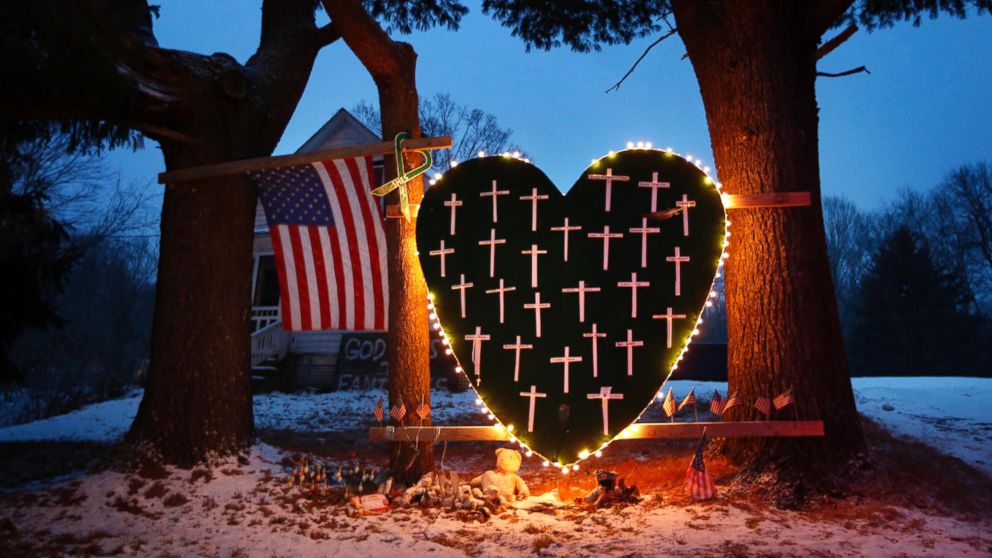
Two Years Since Newtown

PHOTO: A memorial with crosses for the victims of the Sandy Hook Elementary School shooting massacre stands outside a home in Newtown, Conn., on the one-year anniversary of the shootings, Dec. 14, 2013.
Memorial in Newtown /Credit: AP (appeared on ABC News website)
Two years ago on December 14, 2012, a disturbed 20 year-old shot and killed his mother, then drove to Sandy Hook Elementary School in Newtown, Connecticut, and killed 20 children and 6 adults before turning the Bushmaster rifle on himself.  This shooting was supposed to be the one that finally changed everything about the availability of guns in the United States and our national epidemic of gun violence.   It has not.  Thanks to a powerful gun lobby and fanatic "gun rights" advocates, very little has changed at the national level.  It is a disgraceful reminder of the power of special interest group money to prevent legislation for the common good from being enacted.

In the two years since Sandy Hook, there have been 21 deadly school shootings in the United States resulting in 37 deaths, including 5 of the shooters.  Mark Follman at Mother Jones analyzes the past two years of these attacks in a December 9 post and adds that "During the same period, there have been dozens of other gun incidents on school grounds that caused injuries, as well as seven additional cases where someone committed suicide with a firearm, but no one else died."

While action has been minimal to non-existent at the national level, there has been some good legislation passed at the state level - most recently, in the state of Washington voters approved a ballot initiative requiring universal background checks in November.  The Law Center to Prevent Gun Violence summarizes the progress: "In the past two years, states have seen historic and unprecedented progress in adopting gun laws to help keep communities safe from gun violence. A total of 99 new laws strengthening gun regulations have passed in 37 states nationwide since December 12, 2012, and 10 states have made major overhauls to their gun laws. 2014 was a remarkable year for smart gun laws, with California’s Gun Violence Restraining Order law, Washington State’s successful ballot initiative for universal background checks, and seven states adopting legislation to keep guns out of the hands of domestic violence abusers."  You can check out its 2014 Annual Gun Laws State Scorecard at http://gunlawscorecard.org/.

In addition to the successful ballot initiative in Washington, gun-control advocates saw a few other victories on Election Day. In Colorado, the two state senators who were recalled in 2013 by a gun lobby funded recall vote won back their seats.  As the LA Times reported: "...in a little-noticed footnote to Colorado’s closely watched gubernatorial and U.S. Senate races, the Democrats won back both of those seats, and it wasn’t at all close in either Pueblo or Colorado Springs."  And, in the midst of what was a Republican rout, the Democratic governors of Connecticut and Colorado won re-election in November despite gun lobby efforts to unseat them.  Connecticut and Colorado passed some of the toughest gun legislation in the country after the tragedies at Sandy Hook and Aurora.

In recent news, the gun lobby suffered a defeat Monday when, in what CNN analysts called "a small political miracle", the Senate approved Vivek Murthy as Surgeon General.  The gun lobby and their allies on the right had delayed his appointment for more than a year because he dared to say that gun violence is a public health issue.

Also on Monday, the families of nine people killed at Newtown filed suit against the maker and sellers of the Bushmaster AR-15 rifle.  The suit alleges "wrongful death and negligence" and seeks unspecified monetary damages.  "The complaint says the gun allows shooters to inflict unparalleled civilian carnage.  'In order to continue profiting from the sale of AR-15s, defendants chose to disregard the unreasonable risks the rifle posed outside of specialized, highly regulated institutions like the armed forces and law enforcement," the plaintiffs wrote in the complaint...A 2005 law shields gun manufacturers from most lawsuits over criminal use of their products, but it does include an exception for cases where companies should know a weapon is likely to be used in a way that risks injury to others. A lawyer for the Newtown families, Katie Mesner-Hage, said the lawsuit appears to be the first of its kind against a manufacturer to claim that exception." [AP/Huffington Post, Dec. 15]

The public is way ahead of the politicians on this issue with overwhelming majorities favoring common sense gun regulations.  Referring to the re-election of Governors Malloy (CT) and Hickenlooper (CO), the Americans for Principled Leadership website notes: "The public polls on gun safety reforms have been proven out in these two gubernatorial elections. By lopsided majorities the voting public strongly favored the gun safety legislation put in place after the Aurora movie theatre and Sandy Hook Elementary School shootings. It’s only a question of time before other states catch on."

Photo Credit: smartgunlaws.org (Law Center to Prevent Gun Violence)
Once the laws are on the books, we can expect attacks from the gun lobby in the courts - usually on the basis of the Second Amendment.  On the district court level, 2014 saw a number of victories for common sense gun laws,  In September. "U.S. District Court Judge John Darrah handed the gun sense movement yet another legal victory by upholding a local ordinance that prohibits military-style assault weapons and large capacity ammunition magazines (“LCMs”) in the city of Highland Park, Illinois. The decision is the most recent in a growing string of cases unanimously finding that prohibitions on assault weapons and LCMs do not infringe on the Second Amendment...This outcome marks the tenth major court victory for common sense gun laws in 2014. Despite a concerted effort by the gun lobby to challenge a host of reasonable firearm regulations, courts have rejected Second Amendment challenges to laws ranging from universal background checks and firearm registration to safe storage and restrictions on assault weapons and LCMs. The message from the courts is clear: the vast majority of sensible gun laws are fully compatible with the Second Amendment."  [Law Center to Prevent Gun Violence, Sep. 29]

The positive state and local actions on gun regulation make these communities safer.  But other states have passed laws making guns more readily available and present.  Guns can be transported across state lines as easily as people, and action at a national level is also necessary. Unfortunately, after the midterm elections, action at the national level is now more unlikely than ever.

Then there is the question of the Supreme Court.  What will happen when these lower court cases make their inevitable way to the conservative-majority Supreme Court is anybody's guess.  SCOTUS' infamous District of Columbia vs. Heller 5-4 ruling in 2008 upheld a district court ruling that a Washington D.C. law banning handguns and requiring other firearms to be stored unloaded or locked was unconstitutional.  In so doing, they essentially declared that an individual unconnected to service in a militia had the right to "bear arms" - a first ever and unprecedented interpretation.

But the news at SCOTUS is not all bad.  In the court's last term (2013-4), "despite numerous invitations and opportunities, the justices went out of their way to avoid the right to bear arms.  Signs of this were clear...when the court in a 5–4 ruling upheld a major gun control law, the federal ban on 'straw' purchasing without so much as mentioning the Second Amendment." Justice Kennedy is apparently the swing vote on these issues and neither the conservative or liberal justices appeared willing to bet on which side he would vote if the Second Amendment were brought into the case.  "Kennedy seems increasingly less likely to be a solid vote for expansive Second Amendment rights. Indeed, twice [in the 2013-4] term he voted for expansive readings of gun control laws instead. For the NRA, so used to winning in statehouses around the country, this can't be good news." [Slate, June 19]

Related
Let's Repeal the Second Amendment [March 18, 2014]


Monday, March 24, 2014

Obstructing the Judiciary

Justice too long delayed is justice denied.
- Martin Luther King, Jr., Letter from Birmingham Jail


The President of the United States is responsible for nominating judges to the Federal judiciary.  It is the Senate's responsibility to confirm or deny these nominations.  With just 7 months remaining before the 2014 midterm elections, there are 86 vacancies in the Federal courts - roughly 10% of the total Federal judgeships.  Nearly all vacancies have resulted from Republicans blocking Obama nominees in an attempt  to deny the Democratic President his choices and ensure continued Republican control of the judicial branch.  The obstructionism on presidential nominees to Federal judgeships is unprecedented in recent history.


Harry Reid was able to change the Senate rules to prevent filibustering of these nominees to the federal courts.  Should the Republicans gain control of the Senate in 2014, this will no longer matter.  You can rest assured that any Obama nominee sent to a Republican Senate will not be confirmed.  Just look at the decisions of the currently composed Supreme Court to see what the future holds.  Democracy-challenged supporters of the corporations and the wealthy, appointed by Republican Presidents, fill most of the seats on the Court and they've brought us such decisions as Citizens United and the gutting of the Voting Rights Act.  Who can ever forget the Republican majority Supreme Court stopping the vote recount in Florida and handing Bush the Presidency even though Gore had garnered more than a half-million more popular votes nationally?


The Court's favorable ruling on the constitutionality of the Affordable Care Act was still detrimental to the "non-ruling" class.  By making the expansion of Medicaid optional, they effectively eliminated this option for low-wage-earners in most Republican-controlled states.  There has been some movement but as of now, there are still 25 states not moving forward with the ACA's provision for Medicaid expansion.  In the end, those finally denied affordable medical insurance will be in the millions.


The Roberts' corporate court sided with the Chamber of Commerce in 13 of 16 cases during the 2009-2010 term.  Then, in the 2010-2011 term, "the Roberts Court cut down an exemplary Arizona statute that leveled the financial playing field, rejected a [gender discrimination] suit by 1.6 million women against...Wal-Mart, shielded the makers of drugs from lawsuits by patients who had been harmed, smothered lawsuits against mutual fund cheaters and liars, and disallowed a suit by a death row inmate even though the prosecution failed to turn over exculpating evidence." [Reno News & Review, "Top 10 Worst Supreme Court Decisions", March 2012]


Currently there are 49 nominees pending for the 86 vacant judgeships.  Mr. President, please wake up and bring forward nominations for the remaining 37 vacancies before the mid-terms. Senator Reid, please put these nominations on a fast track.


2014 Senate seat contests -lighter color indicates retiring Senator
Why is this important?  Democrats currently hold a 55-45 edge in the Senate (assuming the two independents continue to vote with the Dems).  If just 6 seats change hands, the Republicans will control the Senate.  I don't want to sound too pessimistic about the Democrats' chances of holding onto the Senate but there are 21 Democratic seats at stake in 2014 compared to just 15 Republican seats.  Four of the 21 Democratic seats are held by retiring Senators - South Dakota, Iowa, Michigan and West Virginia.  Of the 17 remaining Democratic incumbents, 5 are from states that went for Romney in 2012.  So that leaves just 12 seats with a returning Democrat running for office in a "blue state".  By my count, that means 9 Democratic Senate seats are up for grabs.


This year's elections promise to the most expensive mid-terms ever.  The money unleashed by Citizens United is flowing freely into the electoral process.  Fact-free negative ads are bouncing around the airwaves.  Voter suppression measures will be taking full effect in November and "government of the people, by the people and for the people" may become a thing of the past.  With the addition of corporate judges to the Federal courts should the Republicans gain the Senate, the oligarchy will be entrenched for a long, long time.


Image
The 2014 Senate election map is from Wikipedia.
The Medicaid expansion map is from the Kaiser Family Foundation website.

Links
"If you prick a corporation, does it not bleed?..." cartoon [New Yorker, March 14, 2011]

Options for low-income people in states denying Medicaid expansion [AllVoices.com, March 22]

Thursday, February 21, 2013

Critical Decision Time at the Supreme Court

The Supreme Court will hear two cases in the coming months that could set back the United States' standing as a modern democracy.  The right-wing activist judges on the court will have the opportunity to overturn both the Voting Rights Act of 1965 and the federal campaign contribution limitations on individuals.  After Citizens United which did away with limits on corporate and labor union contributions, this additional one-two punch to our democracy would set us even further down the road to a plutocracy. 

The Voting Rights Act was one of the most palpable results of the civil rights movement of the late 1950's and early 1960's.  In her excellent analysis in yesterday's New York Times, Linda Greenhouse asks: "How can it be that one of the crowning achievements of the civil rights movement, a provision upheld on four previous occasions by the Supreme Court and re-enacted in 2006 by overwhelming bipartisan majorities in Congress (98-0 in the Senate, 390-33 in the House), a law that President George W. Bush urged the justices to uphold again four years ago in one of his final acts in office, a law that has demonstrably defeated myriad efforts both flagrant and subtle to suppress or dilute the African-American vote, is now hanging by a thread?" 

And what a thin thread that is.  In his opinion on an earlier Voting Rights Act case (2009) involving an election district in Austin, Texas, Chief Justice Roberts stated that "things have changed in the south".  Fortunately the Court did not at that time overturn Section 5 of the Voting Rights Act.  This time around, when the Court hears Shelby County, Alabama petition, we may not be so fortunate. 

Section 5, the pre-clearance provision, requires that the United States Department of Justice or a panel of the United States District Court for the District of Columbia "preclear" any attempt to change “any voting qualification or prerequisite to voting, or standard, practice, or procedure with respect to voting..." in any "covered jurisdiction."  Covered jurisdictions are those with a history of past voting discrimination and in which less than 50% of the population was registered to vote in 1964.  Because of their Jim Crow laws, poll taxes, and the jury-rigged literacy tests with their so called "grandfather clauses", many Southern states require pre-clearance before they can change their voting laws.  Thing of the past, you say?  Just consider the voter suppression laws that numerous Republican-controlled states tried to enact this past election cycle.  Texas' voter suppression law was invalidated before the November election because it was not granted pre-clearance under the Voting Rights Act. 

The Voting Rights Act has done enormous good in allowing all citizens to exercise their right to vote with language that mirrors the 15th Amendment . That Amendment, ratified in 1870, provided that, "The right of U.S. citizens to vote shall not be denied or abridged by the United States or by any State on account of race, color, or previous condition of servitude." Let's hope the current Supreme Court keeps it that way.

Alabama also plays a role in the case arguing against aggregate spending limits for individuals.  The case is brought by Shaun McCutcheon, an Alabama man, and, surprise, surprise, the Republican National Committee. They argue that the current aggregate limits for a two-year cycle , $46,200 for contributions to candidates and $70,800 for contributions to groups, are too low.  As noted by Adam Liptik in the New York Times on February 19: "Should the court agree that those overall limits are unconstitutional, however, its decision could represent a fundamental reassessment of a basic distinction established in Buckley v. Valeo in 1976, which said contributions may be regulated more strictly than expenditures because of their potential for corruption."  Is there any hope at all that this Court, responsible for declaring corporations persons in Citizens United and for striking down campaign finance laws in Vermont (2006) and Montana (2012), will do the right thing for the democracy and prevent the further incursion of Big Money into the political process?

At a time when the influence of money in politics is so overwhelming that even common-sense gun control legislation is bottled up indefinitely in Congress, at a time when Republican governors and legislatures seem hell-bent on denying people their right to vote, the Supreme Court can strike a blow for democracy by holding the line on these two cases.  The Court either can do what is good for the country or it can agree with the right-wing ideologues that have dominated the political conversation for more than 30 years.  These cases will be a test of how far we've gone down the road to plutocracy and how far we've strayed from protecting citizens' right to vote.  I cannot say that I am hopeful.


Thursday, June 28, 2012

A Good Day

The Supreme Court upheld the constitutionality of the Health Care Reform Act, specifically the individual mandate upon which the program rests, by a vote of 5 to 4. They issued their decision this morning.  As summarized by Mike Sachs at the Huffington Post: "The controlling opinion, written by Chief Justice John Roberts, upheld the mandate as a tax, although concluded it was not valid as an exercise of Congress' commerce clause power."  Roberts' vote totally surprised me...my money had been on an overturn of the individual mandate and potential gutting of the law.  (At least I called Justice Kennedy's vote correctly in the last post; he voted with the right-wing justices.)

As the President said in his comments today: this is a victory "for people all over this country".  An overturn of this crucial legislation would have been devastating.  We would not have a reasonable chance at extending medical coverage for Americans for another generation.  In her remarks after the ruling, Nancy Pelosi paid tribute to Ted Kennedy who worked tirelessly during his life to bring universal health care to this country - promoting the concept of health care as a right, not a privilege.  Although she didn't mention herself, the smiling former Speaker Pelosi had been instrumental in holding Democrats together and getting the legislation through the House in 2010.

By a 7-2 vote, the Court struck down the provision of the Health Care Reform Act that would have kicked states out of the Medicaid program if they did not subscribe to the extension of Medicaid provided by the law.  States stand to gain enormously from the legislation - the Federal government provides at least 90% of the funding for Medicaid and significant net savings accrue to the states since they will no longer have to cover medical expenses for the currently uninsured.  In fact, the only reason for states to deny the extended Medicaid coverage to the people of their state is simple mean-spirited ideology.  Unlikely and unreasonable as it seems, some states may opt out.  The legislators in these states will be supported by people who really don't understand the economics or the benefits, by miscellaneous business groups who prefer not to spend on health care, by people who would protect tax breaks for the rich at the expense of services for the less well off and, let's face it, by those bigots who don't want a black President to appear powerful and those who still believe in the racist stereotypes of welfare recipients. 

The post-ruling sour grapes and promises to repeal health care reform from Republicans made them seem as ridiculous on health care as they've been on privatization of Social Security and ending Medicare as we know it.  Of course, this Supreme Court decision may be for nought if the Republicans take control of the White House and Senate in the November elections.  In spite of today's good news, the race between Romney and Obama remains tight.  Every vote will count this November.  With Romney pledging to repeal health care reform, you have some idea of what's at stake.

So what made Chief Justice Roberts side with the four moderate and liberal justices on the court?   David Cole's post in The Nation may have gotten it right: "In part, the outcome reflects the fact that the truly radical position in this dispute was that of the challengers. Even very conservative lower court judges...had concluded that the law was valid ....But in addition, I cannot but think that at the back of Roberts’s mind was the Court’s institutional standing. Had the law been struck down on 'party lines,' the Court’s reputation would be seriously undermined....Today’s result, which upholds the actions of the democratically elected branches on a major piece of social welfare legislation that affects us all against a challenge that was always a real long shot, driven more by politics than legal principle, may help repair the Court’s tarnished image."

So that was this morning.  This afternoon, I enjoyed watching Italy defeat Germany in a Eurocup 2012 semi-final.  They move on to the finals which will be played Sunday.  Yes, it was a very good day.

Monday, June 25, 2012

Today's Mixed Bag

The Supreme Court issued two important decisions today - one on Arizona's anti-immigrant law S. B. 1070 and the other on Montana's state law banning political contributions from corporations, the Corrupt Practices Act. 

First the really bad news.  SCOTUS summarily reversed the Montana Supreme Court's ruling that held Montana's century old ban on corporate political donations to be constitutional and not in violation of Citizens United.  The vote was the same 5-4 as Citizens United with the conservative majority putting to the lie the argument that conservatives support states' rights.  I guess that only applies to those rights that conservatives agree with - such as the unlimited, anonymous corporate donations to political candidates and parties which they astoundingly classified as "free speech".  As summarized in a HuffingtonPost blog today by correspondent Mike Sacks: "By summarily reversing the case, American Tradition Partnership v. Bullock, the justices refused to reconcile their sweeping statement of free speech principles in Citizens United with the real-world facts -- from Montana's history to today's super PACs -- put forward by Montana and its supporters to demonstrate that independent expenditures do, indeed, corrupt or create the appearance of corruption."

The only real answer to Citizens United is a constitutional amendment.  Sen. Bernie Sanders of VT has proposed a constitutional amendment to do just that.  You can find a petition supporting this amendment at his website.   Another option would be to legislate disclosure requirements but the odds of getting this through the Republican-held House and the Republican-throttled Senate are negligible.  These steps will take time and will do nothing to stop the massive flow of anonymous money into the 2012 elections.  We'll have to put up with the negative, often erroneous attacks against Democratic candidates across the country.  We saw what this massive amount of Super Pac and corporate money could do in Wisconsin's failed recall election.  And it is not stopping any time soon.  Sen Sherrod Brown of Ohio, for example, has been the target of more than 10 million dollars trying to unseat him.  With 75-80% of elections decided by the money spent, things do not look good for November.

Now for the kinda bad news.  In a 5-4 vote, with Kennedy joining the moderate and liberal justices, the Supreme Court upheld the constitutionality, at least temporarily and on a technicality, of the "papers please" provision of Arizona's anti-immigrant law S.B. 1070.   SCOTUS did strike down other parts of the law that "made it a crime for undocumented immigrants to be present and to seek employment in Arizona...[and]..authorized police officers to make warrantless arrests of anyone they had probable cause to believe had committed a deportable offense."  These provisions were found to violate the Federal government's authority to regulate immigration. 

What is amazing is that four justices (Scalia, Alito, Thomas, Roberts) were content with allowing some or all of the provisions of this profoundly offensive and discriminatory legislation to stand.  It is clear that civil rights will have some tough sledding in the coming years as these radical activist justices rewrite what it means to be an American and what it means to live in a democracy. 

At least Kennedy had the sense to see how bad the Arizona law was.  He will be the deciding vote on the Health Care Reform Act (probably this Thursday) but I hold little hope for him to act as the moderate swing vote in this crucial decision.  I'm afraid that his Republican/corporate leanings (Florida 2000 recount, Citizens United) will kick in and Obama's signature legislative victory will be sundered. 

The most likely provision to destroy the health care legislation is the individual mandate.  Quick: who first proposed the individual mandate?  If you said Republicans, you would join the 2% of Americans who know this.  It was first proposed by the ultra-conservative Heritage Foundation and supported by numerous Republicans over the years - including Mitt Romney when he was governor of Massachusetts.  In an insightful article today, "young Turk" Cenk Uygur calls the mandate the "perfect symbol of the central mistake of the Obama administration."  But that's for a discussion on another day.